As digital payments become increasingly embedded in everyday financial activity, protecting financial privacy is an important consideration for policymakers, financial institutions, and consumers. The potential introduction of central bank digital currencies (CBDCs) presents opportunities to modernize payment systems, while raising questions about personal data, financial surveillance, and individual freedoms.
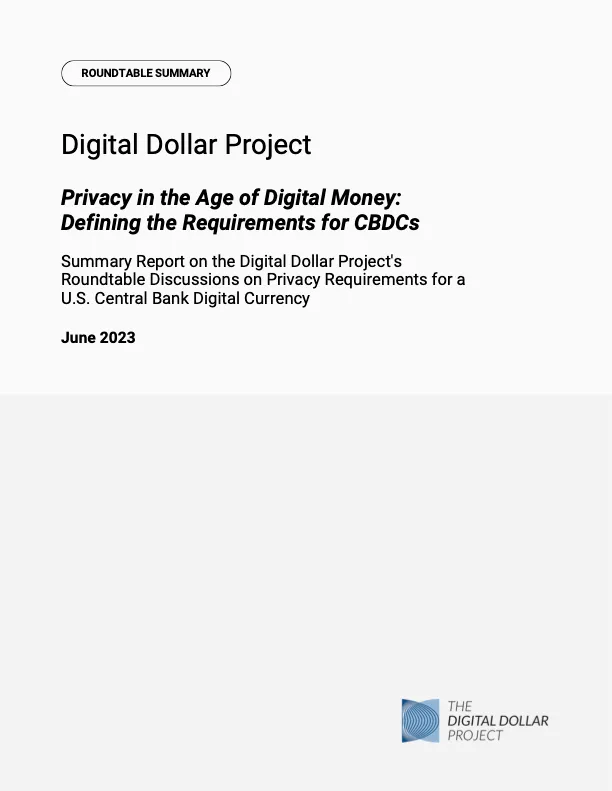
The Digital Dollar Project’s Privacy in the Age of Digital Money: Defining the Requirements for CBDCs explores the privacy principles and design considerations that could inform the development of a potential U.S. central bank digital currency, or digital dollar.
Published in June 2023, the report summarizes roundtable discussions hosted by the Digital Dollar Project in partnership with MIT Connection Science and Engineering, UC Berkeley’s Center for Responsible, Decentralized Intelligence, and Georgetown University Law Center’s Institute of International Economic Law.
This overview highlights the principal findings and research priorities discussed in the report, including financial privacy, cash-like protections, data minimization, and the role of emerging technologies.
Why Financial Privacy Matters for Digital Currencies
As financial transactions increasingly move through digital platforms, the collection and use of personal financial information have become important considerations.
Unlike physical cash, many digital payment methods generate detailed transaction records that can reveal information about individuals’ spending patterns, financial relationships, and activities.
The report highlights concerns about commercial surveillance, the collection of financial data by private companies, and the potential for government agencies to access sensitive transaction information without sufficient safeguards.
These concerns are particularly relevant to the design of a potential U.S. CBDC, which could introduce new capabilities for processing and monitoring financial transactions.
The roundtable discussions emphasized that protecting financial privacy requires clear expectations about how information is collected, stored, accessed, and shared. Establishing these protections would be important to maintaining public confidence in digital currency infrastructure.
Four Core Privacy Principles for a Digital Dollar
The roundtable discussions were guided by the Digital Dollar Project’s Privacy Principles for a Digital Dollar, originally published in October 2021.
These principles identify four foundational objectives for a potential U.S. CBDC:
- Private: Protecting individuals from undue government surveillance and corporate tracking while supporting meaningful control over personal financial information.
- Secure: Providing strong safeguards against theft, fraud, hacking, and illegal seizure through appropriate technical and legal protections.
- Accessible: Supporting affordable financial services, improving payment efficiency, and expanding opportunities for individuals who are underserved by existing financial systems.
- Transparent: Ensuring that the technical operation, security, and privacy safeguards of a digital dollar can be independently evaluated.
Together, these principles provide a foundation for considering how digital currency infrastructure could support financial innovation while preserving individual rights and public trust.
Preserving Cash-Like Privacy and Payment Choice
A central theme of the report is the importance of maintaining privacy protections comparable to those associated with physical cash.
Although cash transactions are not completely anonymous, they generally offer greater individual privacy than many existing digital payment methods.
The roundtable participants identified several characteristics that could inform the design of a potential retail digital dollar, including resilience, resistance to inappropriate transaction censorship, and continued access to central bank money.
The report also emphasizes the importance of payment choice. Individuals should retain the ability to use cash, credit and debit cards, digital payment applications, and other forms of money according to their needs.
Rather than replacing existing payment methods, a potential digital dollar should be considered within a broader financial ecosystem that preserves consumer choice and individual autonomy.
Privacy by Default and Data Minimization
The report identifies privacy by default and data minimization as important considerations for CBDC development.
Rather than relying exclusively on lengthy disclosure agreements or user consent, digital currency infrastructure could be designed to limit unnecessary collection of personal information from the outset.
Data minimization involves collecting and processing only the information necessary for a specific purpose.
In the context of a digital dollar, this could include exploring ways to separate personal identity information from transaction data and reduce reliance on unnecessary identifiers.
The roundtable discussions also considered the potential role of decentralized identity technologies in supporting privacy-preserving financial transactions.
These approaches could help establish stronger protections for users while allowing digital currency systems to meet appropriate security and regulatory requirements.
Privacy-Enhancing Technologies and Regulatory Considerations
Advances in cryptography and digital identity technologies may provide new approaches to protecting financial information.
The report identifies several privacy-enhancing technologies for further exploration, including zero-knowledge proofs, homomorphic encryption, differential privacy, and trusted execution environments.
These technologies could potentially reduce trade-offs between financial privacy, security, and legitimate regulatory objectives, although further research is necessary to understand their practical suitability for CBDC infrastructure.
The discussions also examined the need to balance individual privacy with financial crime prevention, due process, and appropriate transaction controls.
Clear safeguards would be essential where digital currency systems permit transactions to be monitored, restricted, or blocked.
The report emphasizes that effective privacy protections require coordination between technical design, legal frameworks, and public policy.
Advancing Research Into CBDC Privacy Requirements
The development of a potential digital dollar requires careful consideration of how privacy protections can be incorporated into monetary infrastructure.
Through its roundtable discussions, the Digital Dollar Project identifies design considerations and research priorities intended to support more informed evaluation of U.S. CBDC privacy requirements.
The report calls for continued collaboration between policymakers, technologists, financial institutions, researchers, and potential users.
Rather than prescribing a definitive CBDC model, Privacy in the Age of Digital Money provides a foundation for further research and discussion about how digital currency innovation could develop while protecting financial privacy, individual freedoms, and public trust.