As central banks explore the development of digital currencies, protecting financial privacy is becoming an increasingly important consideration for policymakers, financial institutions, and consumers.
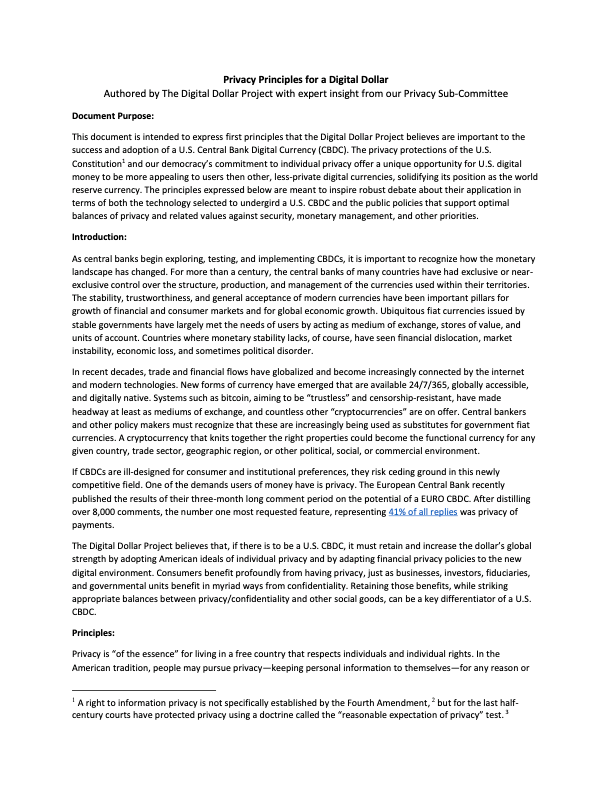
The Digital Dollar Project’s Privacy Principles for a Digital Dollar establishes four foundational principles intended to guide discussions about the potential development of a U.S. central bank digital currency (CBDC), or digital dollar.
Published in October 2021 and authored by the Digital Dollar Project with expert input from its Privacy Sub-Committee, the paper examines how financial privacy, security, accessibility, and transparency could inform the design and operation of a potential U.S. CBDC.
This overview highlights the four principles and the legal and policy considerations identified in the publication, including individual privacy rights, financial surveillance, and the balance between personal freedom and financial crime prevention.
Why Financial Privacy Matters for a U.S. Digital Dollar
The growth of digital currencies and emerging payment technologies is changing how money is stored, transferred, and exchanged.
As financial systems become increasingly digital, maintaining individual privacy and protecting sensitive financial information are important considerations for central banks and policymakers.
The paper highlights the importance of privacy to individuals, businesses, investors, and institutions, emphasizing its role in protecting personal autonomy, confidential relationships, and legitimate financial activities.
It also references research conducted by the European Central Bank during its early exploration of a digital euro. In consultation results cited in the 2021 publication, privacy was the most frequently requested feature, accounting for 41% of responses.
The Digital Dollar Project argues that strong privacy protections could help distinguish a potential U.S. CBDC from less-private digital currency alternatives while supporting trust and confidence in the U.S. dollar.
Four Core Privacy Principles for a Digital Dollar
The Digital Dollar Project identifies four principles that it believes should guide the development and evaluation of a potential U.S. central bank digital currency.
1. Private
Individuals should be able to use a digital dollar without being subjected to undue government surveillance or corporate tracking.
Users should retain meaningful control over how their financial information is shared, while government access to transaction data should be governed by due process and applicable U.S. law.
2. Secure
A digital dollar should provide strong protections against theft, fraud, hacking, and illegal seizure.
The underlying infrastructure and the tools used to access digital currency should incorporate appropriate technical and legal safeguards.
3. Accessible
A potential U.S. CBDC should improve access to financial services for individuals and businesses.
Greater payment efficiency, lower transaction costs, and increased competition could help expand financial participation, particularly among unbanked and underbanked communities.
4. Transparent
Digital currency infrastructure should operate transparently enough for independent organizations to evaluate its technical functioning, security, and privacy safeguards.
This would help users and other stakeholders assess whether the system operates as intended and is protected against unauthorized monitoring.
Together, these principles establish a foundation for considering how financial privacy and related public policy objectives could be incorporated into digital currency design.
Financial Privacy and Constitutional Protections
The paper examines how existing U.S. legal protections might apply to financial information generated by a potential digital dollar.
In particular, it considers the Fourth Amendment and the evolving interpretation of privacy rights in an increasingly digital environment.
The research discusses the third-party doctrine, which has historically influenced how information held by financial institutions is treated under U.S. law.
As digital technologies create increasingly detailed records of personal activity, questions arise about whether existing legal frameworks provide appropriate protections for sensitive transaction information.
The Digital Dollar Project emphasizes the importance of evaluating how constitutional protections could apply to CBDC data, including information revealing personal relationships, commercial activities, and other private financial matters.
Balancing Financial Privacy and Financial Crime Prevention
Developing a potential digital dollar would require balancing individual privacy rights with legitimate law enforcement, national security, and financial crime prevention requirements.
The paper recognizes that financial institutions already operate within legal frameworks that permit access to certain information under defined circumstances.
However, digital currency infrastructure could introduce new capabilities for collecting and analyzing financial transactions, potentially expanding government access to sensitive data.
The research considers how existing safeguards, including reporting requirements, subpoenas, and judicial oversight, might need to be reconsidered as digital currency technologies develop.
It also raises questions about automated transaction restrictions, the potential for inappropriate financial surveillance, and the mechanisms available to individuals when decisions are made incorrectly.
These considerations highlight the importance of establishing clear legal protections and appropriate accountability within any future digital dollar system.
Building a Framework for Responsible Digital Dollar Innovation
The introduction of a U.S. central bank digital currency would involve important decisions about technology, financial infrastructure, privacy, and public policy.
Through its four foundational principles, the Digital Dollar Project provides an initial framework for examining how a potential digital dollar could protect individual freedoms while supporting security, financial inclusion, and transparency.
The paper emphasizes that existing laws and regulatory approaches may require reassessment to address the capabilities and challenges associated with new digital currency systems.
Rather than prescribing a specific CBDC model or technical solution, Privacy Principles for a Digital Dollar is intended to encourage further research, discussion, and collaboration.
Its principles contribute to the broader conversation about how digital money could evolve while maintaining financial privacy, protecting individual rights, and supporting public trust.